
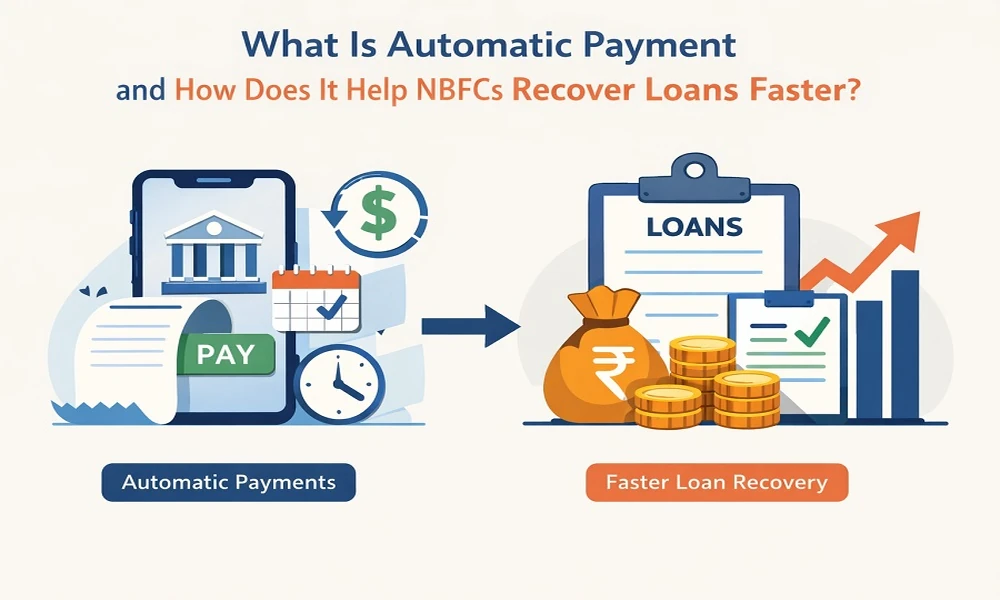
Loan repayment management has always been one of the trickiest parts of running an NBFC. Borrowers forget due dates, collection agents spend hours on follow-up calls, and finance teams end up reconciling payments manually well after the fact. With loan books growing larger every year, this kind of manual effort simply doesn’t scale. That’s pushed many NBFCs toward automatic payment systems, which handle recurring EMI deductions without needing a borrower to actively initiate anything each month.
Understanding Automatic Payment
At its core, automatic payment refers to a system where a borrower authorizes a lender, once, to debit a fixed amount from their bank account on scheduled dates. Once this authorization is set up, usually through net banking or a digital mandate, payments process automatically without the borrower having to log in or transfer money manually each time. The underlying digital payment infrastructure handles everything in the background, checking account balances, processing debits, and updating records on the lender’s side almost instantly. For NBFCs managing recurring loan repayments, this kind of automation removes a huge amount of guesswork from the collection process.
Loan Recovery Challenges for NBFCs
Before automatic payment became common, NBFCs dealt with a fairly predictable set of headaches. Missed repayment dates were frequent, not always because borrowers couldn’t pay, but because they simply forgot or got distracted by other priorities. This meant collection teams had to make manual follow-up calls, which is time consuming and doesn’t always lead anywhere productive. Delays in collection created ripple effects on cash flow planning, and the operational workload of tracking thousands of individual repayments by hand stretched finance teams thin. For NBFCs with large, geographically spread borrower bases, especially those serving semi-urban and rural customers, this problem only got more complicated.
How Automatic Payment Helps NBFCs
Most of these issues are solved directly by the automatic payment. There is a substantial reduction in payment delays as the debits are made on the predetermined date without any borrower action. Repayment consistency is better as well because the system doesn’t depend on a borrower remembering or being motivated every month. Handwritten collection processes are reduced and staff can be used more effectively to concentrate on more productive work, such as credit risk assessment, rather than chasing non-payment. Moreover, cash flow planning is also easier for the NBFC, as the cash inflow gets predictable throughout the loan portfolio. And, for the borrowers, not having to make the effort to pay every month is just easier and easier to do and that means there’s less unintentional default.
Benefits for Lenders and Customers
Both sides of the lending relationship gain something from a well functioning automatic payment setup. Lenders see faster repayment processing, since funds move directly from the borrower’s account without intermediate manual steps. Tracking and transparency improve as well, with dashboards showing exactly which payments succeeded and which failed, often within hours rather than days. Borrowers, meanwhile, get a smoother experience overall, since they don’t need to remember dates or manually transfer money each cycle. For NBFCs juggling thousands of active loans, this translates into noticeably more efficient loan management across the board.
Conclusion
In India, automated repayment methods are quietly transforming the loan recovery landscape, with automatic payment as a key component. This will free up a lot of resources for NBFCs to invest in their loans rather than chasing after repayments, thereby adopting a more responsible approach. With the ongoing growth of the digital lending landscape into newer segments of borrowers in India, NBFCs with robust automatic payment systems in place stand to gain in terms of being better prepared for the volume and complexity of lending business going forward.
